A knowledge acquisition tool that reimagines how students study. Upload your notes, and Cogito deconstructs them into structured, interactive study modules — turning passive reading into active learning. Designed and built by KCT from a doctor's vision.
Most students study by reading their notes over and over. They highlight passages, maybe rewrite key sections, and hope the information sticks. It's passive, it's slow, and — according to decades of learning science — it doesn't work very well. The way most people study is fundamentally broken.
The founder of Cogito, a medical doctor, had seen this firsthand. Through years of medical education and observing how his peers struggled with dense, technical material, he'd developed a structured process for breaking down complex notes into digestible, testable components. The process worked. But it was entirely manual — time-consuming and impossible to scale.
He came to KCT with a clear vision: take this proven learning methodology and turn it into a mobile app that students would not just use, but genuinely enjoy using. The product needed to feel less like a study tool and more like an experience — something that could compete for attention against social media, not just against other flashcard apps.
Cogito is a mobile app for iOS and Android that transforms how students interact with their study material. The core flow is simple: upload a note, and Cogito's AI deconstructs it into logical paragraphs and structured study modules. But beneath that simplicity is a carefully designed experience.
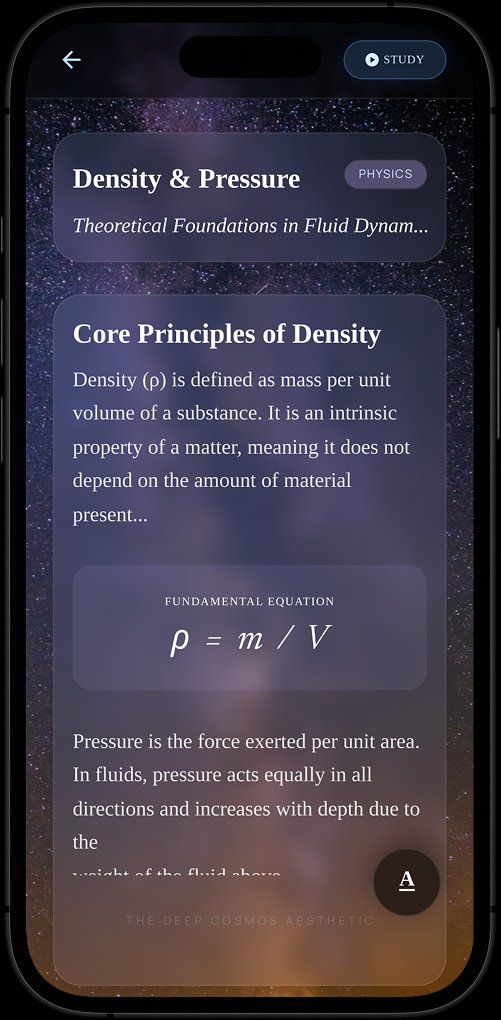
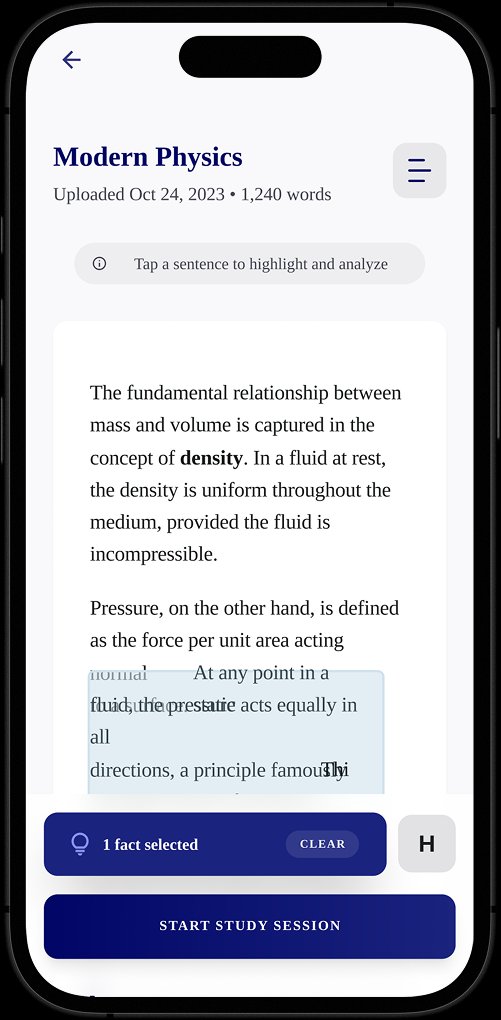
The note reader lets students tap any sentence to highlight and analyze it — selecting key facts that become the foundation of their study session. Once they've marked what matters, they launch a study session where the content is presented in structured cards: core principles broken down into clear explanations, fundamental equations rendered cleanly, and key concepts organized by topic.
The study mode was a design challenge in itself. We created the "Deep Cosmos" aesthetic — a rich, immersive visual environment that makes studying feel less like a chore and more like exploration. The dark, atmospheric backgrounds with warm gradients give the study cards a sense of depth and focus that keeps students engaged rather than reaching for Instagram.
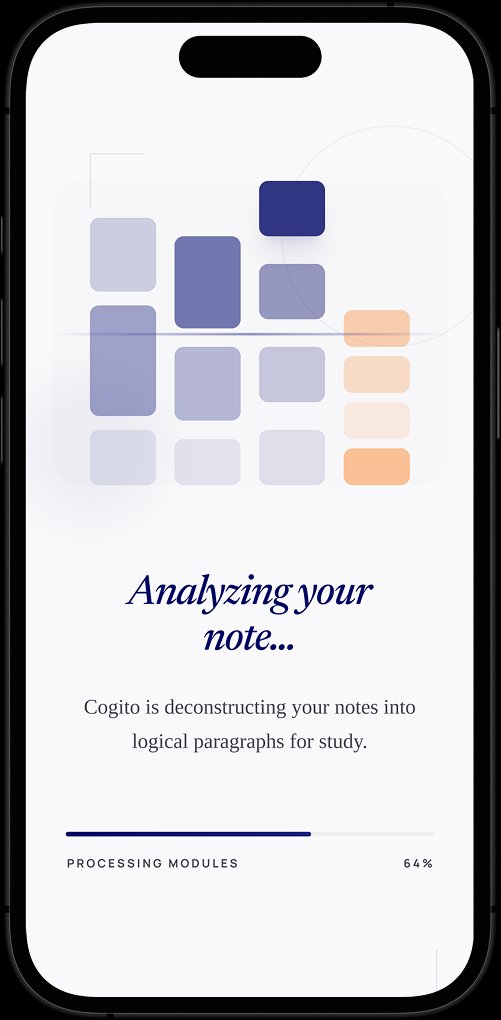
The processing screen — where Cogito breaks down uploaded notes — was designed to feel intelligent rather than passive. Students watch as their notes are deconstructed into logical modules in real time, building anticipation for the study session ahead.
The biggest risk with educational apps is building something that feels educational — clinical, sterile, obligatory. The founder was clear from the start: this had to be something students wanted to open, not something they forced themselves to use.
We designed Cogito to feel premium. The typography is intentional — serif headings that give the content a sense of weight and authority, clean sans-serif body text for readability. The color system shifts between a focused, bright note-reading mode and the deep, atmospheric study mode, creating a psychological transition from input to learning. Every interaction — from tapping a sentence to highlight it, to watching the progress bar as modules are processed — was designed to feel responsive and satisfying.
The result is an app that takes learning seriously without taking itself too seriously. It's a tool built by a doctor, designed by KCT, and made for students who want to study smarter.
We'll design and build it — from concept to App Store.
Start a conversation →